-
What happened?
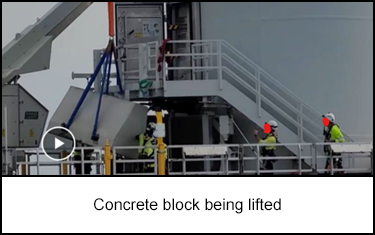
During a live test simulating a transformer lift between the transition piece (TP) and the service operational vessel (SOV) deck, a 6.5T (22,046 lbs) concrete block was being lifted.
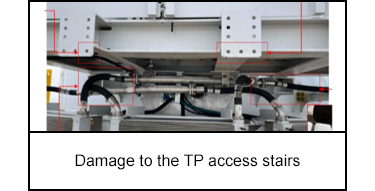
The block began to swing uncontrollably during the final section of the lift, causing it to hit and damage the TP access stairs.
No personnel were injured, but the incident highlighted significant operational and procedural weaknesses.
-
Why did it happen?
Tugger lines, typically used to control oscillation, were not used due to winch location and platform height limitations.
The vessel crew were not involved in the lift planning or preparation, leading to a lack of shared understanding.
The vessel was deballasted before the lift, resulting in unexpected rolling that caused the swing.
The vessel used was not adequately specified or suited for this type of lifting operation.
Operational communication between the bridge and the lifting team was insufficient.
-
What did they learn?
Lifting teams must ensure the crane operator has a clear view of the load or stop the work if guidance tools are not available.
Lifting stakeholders, including vessel crews, must be involved in planning to anticipate vessel and environmental behaviour.
All blank tests and risk mitigation strategies (e.g., oversizing slings) must be formally included in lifting plans.
Tooling at the landing area should be improved to better manage movement (e.g., silent blocks, bumpers, snatch blocks).
Vessel selection must consider operational stability and be verified against weather conditions and lift specifics.
Preparation on-site is as critical as engineering office planning.

-
Ask yourself or your crew
Have we ever lifted with unclear visibility or without tugger/tagline control? What did we do?
How confident are we in our vessel selection process for complex lifting operations?
Do we always involve the right people in the lifting plan development?
What would we do if the vessel started rolling mid-lift? Do we have a plan?
Could a "stop the work" culture be stronger within our lifting teams?
Add to homescreen
Content name
Select existing category:
Content name
New collection
Edit collection
What happened?
During a live test simulating a transformer lift between the transition piece (TP) and the service operational vessel (SOV) deck, a 6.5T (22,046 lbs) concrete block was being lifted.
The block began to swing uncontrollably during the final section of the lift, causing it to hit and damage the TP access stairs.
No personnel were injured, but the incident highlighted significant operational and procedural weaknesses.

Why did it happen?
Tugger lines, typically used to control oscillation, were not used due to winch location and platform height limitations.
The vessel crew were not involved in the lift planning or preparation, leading to a lack of shared understanding.
The vessel was deballasted before the lift, resulting in unexpected rolling that caused the swing.
The vessel used was not adequately specified or suited for this type of lifting operation.
Operational communication between the bridge and the lifting team was insufficient.

What did they learn?
Lifting teams must ensure the crane operator has a clear view of the load or stop the work if guidance tools are not available.
Lifting stakeholders, including vessel crews, must be involved in planning to anticipate vessel and environmental behaviour.
All blank tests and risk mitigation strategies (e.g., oversizing slings) must be formally included in lifting plans.
Tooling at the landing area should be improved to better manage movement (e.g., silent blocks, bumpers, snatch blocks).
Vessel selection must consider operational stability and be verified against weather conditions and lift specifics.
Preparation on-site is as critical as engineering office planning.

Ask yourself or your crew
Have we ever lifted with unclear visibility or without tugger/tagline control? What did we do?
How confident are we in our vessel selection process for complex lifting operations?
Do we always involve the right people in the lifting plan development?
What would we do if the vessel started rolling mid-lift? Do we have a plan?
Could a "stop the work" culture be stronger within our lifting teams?
A 6.5T (22,046lbs) concrete block swung uncontrollably during a test lift and struck the TP access stairs, causing damage but no injuries.