-
What happened?
A technician was instructed to repopulate M64 fastening studs on a tower grillage flange in preparation for increasing wind speeds in the area.
While installing one of the fastening studs, the accompanying spacer used to guide the stud into the hole shifted.
This led to the stud falling through the flange opening.
The technician instinctively attempted to grab the stud, which led to their hand being crushed between the stud's nut and the spacer.
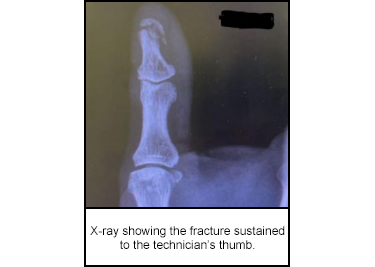
This led to a crush type injury on the thumb of the technician’s left hand.
The technician immediately reported the incident to the team lead, who alerted the bridge to the need for medical assistance.
-
Why did it happen?
The technician reacted instinctively to prevent the spacer from falling.
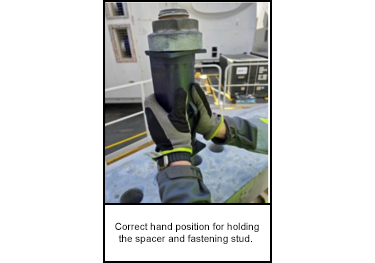
The technician had been holding the stud incorrectly for the task they were doing.
The task was poorly planned because it was deemed an emergency fix during increasing wind speeds.
-
What did they learn?
Refitting the bolts was not included in the risk assessment and method statement (RAMS) for tower installation at the time of the event.
Demonstrations of the correct hand placement for this and similar tasks have been performed for both day- and night-shift workers.
The RAMS should be updated to reflect bold repopulation contingency measures.
Mechanical aids should be used and included in the updated RAMS.

-
Ask yourself or your crew
Are you aware of the correct hand placement when performing specific tasks?
Is the maintenance work you are completing included in the RAMS?
Have demonstrations and instructions for the task been communicated clearly?
What safety measures, procedures, controls or barriers do we have in place to mitigate the risk of an event like this?

Add to homescreen
Content name
Select existing category:
Content name
New collection
Edit collection

What happened?
A technician was instructed to repopulate M64 fastening studs on a tower grillage flange in preparation for increasing wind speeds in the area.
While installing one of the fastening studs, the accompanying spacer used to guide the stud into the hole shifted.
This led to the stud falling through the flange opening.
The technician instinctively attempted to grab the stud, which led to their hand being crushed between the stud's nut and the spacer.
This led to a crush type injury on the thumb of the technician’s left hand.
The technician immediately reported the incident to the team lead, who alerted the bridge to the need for medical assistance.

Why did it happen?
The technician reacted instinctively to prevent the spacer from falling.
The technician had been holding the stud incorrectly for the task they were doing.
The task was poorly planned because it was deemed an emergency fix during increasing wind speeds.

What did they learn?
Refitting the bolts was not included in the risk assessment and method statement (RAMS) for tower installation at the time of the event.
Demonstrations of the correct hand placement for this and similar tasks have been performed for both day- and night-shift workers.
The RAMS should be updated to reflect bold repopulation contingency measures.
Mechanical aids should be used and included in the updated RAMS.

Ask yourself or your crew
Are you aware of the correct hand placement when performing specific tasks?
Is the maintenance work you are completing included in the RAMS?
Have demonstrations and instructions for the task been communicated clearly?
What safety measures, procedures, controls or barriers do we have in place to mitigate the risk of an event like this?
A technician sustained a thumb crush injury while installing a fastening stud during urgent offshore wind maintenance.