-
What happened?
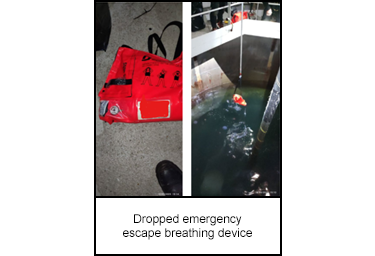
While lowering an emergency escape breathing device (EEBD) from the air tight platform (ATP) to the lower working platform (LWP), a karabiner was used but not fully closed.
The karabiner was incorrectly attached to the EEBD handle, which is not designed for lifting.
Midway through the descent, the EEBD struck the ladder and fell into the water.
Other workers were present on the LWP but were not injured.
The EEBD floated and was recovered, removed from service, and sent for inspection.
-
Why did it happen?
The karabiner was not properly secured, and its closure was not verified before use.
The EEBD’s carry handle (not rated for lifting) was used instead of a proper lifting attachment.
A lifting bag was not used, contrary to standard procedures for small equipment transport.
There was a lack of proper checking, awareness, and supervision during the lift.
There was likely insufficient training or reinforcement of manual lifting protocols, particularly for subcontractors.

-
What did they learn?
Only rated and appropriate lifting gear should be used for lowering or hoisting equipment.
Karabiners must be checked to ensure they are fully closed and secure before lifting.
Handles not designed for lifting (e.g., bag straps) must never be used to suspend loads.
Toolbox Talks and awareness sessions should be conducted with a focus on lifting practices.
Subcontractors and new personnel need clear guidance on lifting protocols before starting work.
Near-misses like this highlight the importance of pre-lift checks, supervision, and procedural compliance.

-
Ask yourself or your crew
Are attachment points and lifting equipment verified before lowering loads?
Are all team members trained and aware of the correct lifting tools for different tasks?
What would have happened if someone was standing directly under the load?
How do we ensure subcontractors follow our lifting procedures?

Add to homescreen
Content name
Select existing category:
Content name
New collection
Edit collection

What happened?
While lowering an emergency escape breathing device (EEBD) from the air tight platform (ATP) to the lower working platform (LWP), a karabiner was used but not fully closed.
The karabiner was incorrectly attached to the EEBD handle, which is not designed for lifting.
Midway through the descent, the EEBD struck the ladder and fell into the water.
Other workers were present on the LWP but were not injured.
The EEBD floated and was recovered, removed from service, and sent for inspection.

Why did it happen?
The karabiner was not properly secured, and its closure was not verified before use.
The EEBD’s carry handle (not rated for lifting) was used instead of a proper lifting attachment.
A lifting bag was not used, contrary to standard procedures for small equipment transport.
There was a lack of proper checking, awareness, and supervision during the lift.
There was likely insufficient training or reinforcement of manual lifting protocols, particularly for subcontractors.

What did they learn?
Only rated and appropriate lifting gear should be used for lowering or hoisting equipment.
Karabiners must be checked to ensure they are fully closed and secure before lifting.
Handles not designed for lifting (e.g., bag straps) must never be used to suspend loads.
Toolbox Talks and awareness sessions should be conducted with a focus on lifting practices.
Subcontractors and new personnel need clear guidance on lifting protocols before starting work.
Near-misses like this highlight the importance of pre-lift checks, supervision, and procedural compliance.

Ask yourself or your crew
Are attachment points and lifting equipment verified before lowering loads?
Are all team members trained and aware of the correct lifting tools for different tasks?
What would have happened if someone was standing directly under the load?
How do we ensure subcontractors follow our lifting procedures?
A poorly secured karabiner caused an EEBD to strike a ladder and fall into the water during lowering, but no workers were injured and the device was recovered.