-
What happened?
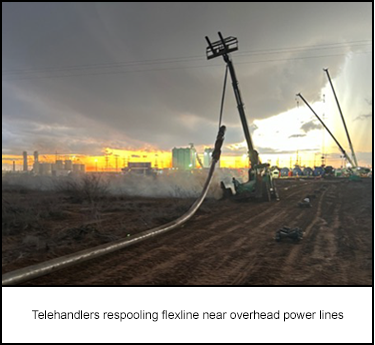
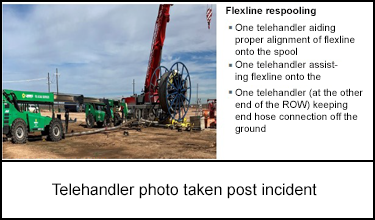
Three telehandlers were being used to respool approximately 200 m (656 ft) of flexline in a right of way between two well pads.
A telehandler raised the flexline end connection and its forks contacted a third-party 21.6 kV overhead power line.
The telehandler became energised and caught fire, but the operator exited without injury.
A second crew member approached with a fire extinguisher and then moved towards the energised telehandler.
The crew member reached towards the telehandler, was knocked down and fatally injured.
-
Why did it happen?
The flexline was located in rough terrain with elevation changes, flowlines and overhead power lines nearby.
The procedure for lifting and rigging during flexline respooling was unclear.
A 6 m (20 ft) strap in a single choke required the boom to be raised higher to lift the hose connection.
The reclosers were bypassed, and a job safety analysis requirement to de-energise the power line was not applied.
The risk assessment and pre-job walk-through did not assess remote fracturing or right-of-way hazards and controls.
-
What did they learn?
Ensure new processes or work methods trigger management of change controls and associated work-planning updates.
Clarify client and contractor responsibilities at work interfaces.
Update overhead power-line controls and ensure that work away from the well pad is fully included.
Train and drill frontline personnel in the initial actions required during an electrical emergency.
Identify all energy sources and verify that hazardous energy is isolated before work begins.

-
Ask yourself or your crew
How do we identify overhead power-line hazards before operating mobile plant?
Are our lifting and rigging procedures clear about controls required near overhead electrical hazards?
How do our risk assessments and pre-job walk-throughs include contractors, off-pad work and changed work methods?
How do we verify that power lines are de-energised and safety devices have not been bypassed?
During an electrical emergency, how do we prevent people approaching energised plant and maintain an exclusion zone?

Add to homescreen
Content name
Select existing category:
Content name
New collection
Edit collection

What happened?
Three telehandlers were being used to respool approximately 200 m (656 ft) of flexline in a right of way between two well pads.
A telehandler raised the flexline end connection and its forks contacted a third-party 21.6 kV overhead power line.
The telehandler became energised and caught fire, but the operator exited without injury.
A second crew member approached with a fire extinguisher and then moved towards the energised telehandler.
The crew member reached towards the telehandler, was knocked down and fatally injured.

Why did it happen?
The flexline was located in rough terrain with elevation changes, flowlines and overhead power lines nearby.
The procedure for lifting and rigging during flexline respooling was unclear.
A 6 m (20 ft) strap in a single choke required the boom to be raised higher to lift the hose connection.
The reclosers were bypassed, and a job safety analysis requirement to de-energise the power line was not applied.
The risk assessment and pre-job walk-through did not assess remote fracturing or right-of-way hazards and controls.

What did they learn?
Ensure new processes or work methods trigger management of change controls and associated work-planning updates.
Clarify client and contractor responsibilities at work interfaces.
Update overhead power-line controls and ensure that work away from the well pad is fully included.
Train and drill frontline personnel in the initial actions required during an electrical emergency.
Identify all energy sources and verify that hazardous energy is isolated before work begins.

Ask yourself or your crew
How do we identify overhead power-line hazards before operating mobile plant?
Are our lifting and rigging procedures clear about controls required near overhead electrical hazards?
How do our risk assessments and pre-job walk-throughs include contractors, off-pad work and changed work methods?
How do we verify that power lines are de-energised and safety devices have not been bypassed?
During an electrical emergency, how do we prevent people approaching energised plant and maintain an exclusion zone?
A telehandler contacted a 21.6 kV overhead power line while respooling flexline. A crew member approached the energised plant and was killed.
Original material courtesy of Safer Together (Australia)
Further information: https://www.safertogether.com.au/learning-event-bulletins/operating-mobile-plant-contact-with-live-electricity-leb-and-toolbox
IOGP Life Saving Rules https://www.iogp.org/workstreams/safety/safety/life-savingrules/
Onshore Safety Alliance – Safety Alerts https://www.onshoresafetyalliance.org/Industry-Safety-Data/Safety-Alerts
Safe Work Australia – Electrical Safety Overview https://www.safeworkaustralia.gov.au/safety-topic/hazards/electrical-safety/overview