-
What happened?
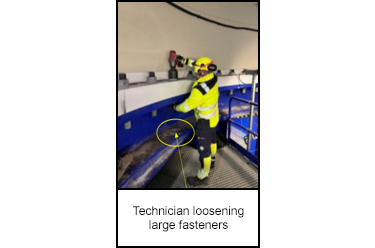
During tower installation works, a technician was loosening large fasteners connecting two structural components.
As the top nut was removed, the lower nut and stud assembly, weighing approximately 16 kg (35lbs), became dislodged and fell.
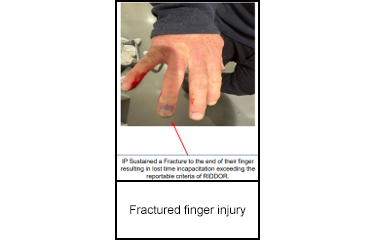
The falling bolt struck the technician’s hand, causing an injury to the tip of their right fourth finger.
Work was immediately stopped, the injured person was treated by the vessel medic, and further medical assessment was arranged.
A site-wide ‘stop for safety’ was held to brief the team and raise awareness of safe handling procedures during de-tensioning tasks.
-
Why did it happen?
The technician placed their hand in the line of fire while de-tensioning the stud, seeking a more comfortable grip position.
The work instruction did not adequately address safe hand placement or follow the hierarchy of controls to minimise risk.
Gaps in training and verification processes led to insufficient task-specific competence.
Inconsistent onboarding procedures failed to confirm minimum competence and training standards before task allocation.

-
What did they learn?
A site-wide ‘stop for safety’ was completed, focusing on raising awareness of line of fire hazards.
Task-specific risk assessment and method statement (RAMS) and work instructions were reviewed and updated to strengthen safe working practices.
Engineering teams are reviewing the work method to identify opportunities for additional engineering controls.
Enhanced auditing and verification of training and competence requirements are being implemented.
The onboarding process and training matrix are being reviewed to ensure alignment with task-specific competence and safety expectations.
-
Ask yourself or your crew
How can technicians better identify and avoid placing body parts in the line of fire during de-tensioning tasks?
What changes to work instructions can ensure safer hand positioning and adherence to the hierarchy of controls?
How can training and onboarding processes be improved to ensure all personnel are fully qualified for specific tasks?
What procedural controls could be introduced to reduce manual handling risks during de-tensioning operations?

Add to homescreen
Content name
Select existing category:
Content name
New collection
Edit collection

What happened?
During tower installation works, a technician was loosening large fasteners connecting two structural components.
As the top nut was removed, the lower nut and stud assembly, weighing approximately 16 kg (35lbs), became dislodged and fell.
The falling bolt struck the technician’s hand, causing an injury to the tip of their right fourth finger.
Work was immediately stopped, the injured person was treated by the vessel medic, and further medical assessment was arranged.
A site-wide ‘stop for safety’ was held to brief the team and raise awareness of safe handling procedures during de-tensioning tasks.

Why did it happen?
The technician placed their hand in the line of fire while de-tensioning the stud, seeking a more comfortable grip position.
The work instruction did not adequately address safe hand placement or follow the hierarchy of controls to minimise risk.
Gaps in training and verification processes led to insufficient task-specific competence.
Inconsistent onboarding procedures failed to confirm minimum competence and training standards before task allocation.

What did they learn?
A site-wide ‘stop for safety’ was completed, focusing on raising awareness of line of fire hazards.
Task-specific risk assessment and method statement (RAMS) and work instructions were reviewed and updated to strengthen safe working practices.
Engineering teams are reviewing the work method to identify opportunities for additional engineering controls.
Enhanced auditing and verification of training and competence requirements are being implemented.
The onboarding process and training matrix are being reviewed to ensure alignment with task-specific competence and safety expectations.

Ask yourself or your crew
How can technicians better identify and avoid placing body parts in the line of fire during de-tensioning tasks?
What changes to work instructions can ensure safer hand positioning and adherence to the hierarchy of controls?
How can training and onboarding processes be improved to ensure all personnel are fully qualified for specific tasks?
What procedural controls could be introduced to reduce manual handling risks during de-tensioning operations?
During tower installation works, a technician injured their finger due to a falling nut and stud assembly.