-
What happened?
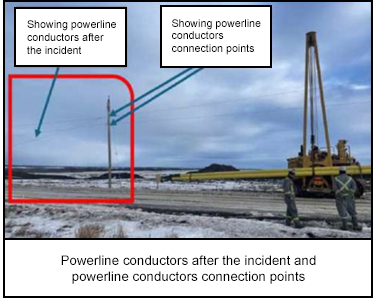
A tracked sideboom was in the process of relocating three lengths of pipe on a rural road. Three overhead powerlines were in the path, two of which were identified as the task began. After successfully crossing the first line, the boom contacted a second line that was not identified and parted an energised 25kV powerline.
No injuries occurred; this incident was considered to have a serious injury or fatality (SIF) potential due to the presence of electrical energy.
-
Why did it happen?
Due to conditions, the contractor’s supervisor moved the pipelayer from the right-of-way and designated travel path to the public roadway.
The change in route bypassed physical barriers intended to prevent overhead line contact.
The field level hazard assessment (FLHA) conducted prior to beginning work was not fully complete.
An updated FLHA was not completed when the work scope changed; the FLHA did not account for hazards of alternate routes.
It was not identified that the change in route resulted in physical controls intended to prevent overhead line contact being absent.
Two of three overhead lines were identified; however, the walkdown of the new route was not complete, resulting in one line being missed.
Cloudy conditions resulted in overhead lines blending with skyline.
The supervisor and sideboom operator were not adequately trained for their respective roles.

-
What did they learn?
Engage with contractors to understand their supervisor competency programs.
Verification of training and competency assessments are required for contract supervisors.
The contractor’s construction kick-off checklist was updated to include a requirement for the site supervisor to validate competency of their crews.
Understand how site supervisors handle changes from planned work (i.e., work as imagined vs work as done).
Revise how written programs address controlled and uncontrolled overhead line crossings.

-
Ask yourself or your crew
Could a similar incident happen at your site?
How do we respond when scope shifts, even when perceived risk is low?
Do we have a clear process for re-assessing risk when plans change?

Add to homescreen
Content name
Select existing category:
Content name
New collection
Edit collection

What happened?
A tracked sideboom was in the process of relocating three lengths of pipe on a rural road. Three overhead powerlines were in the path, two of which were identified as the task began. After successfully crossing the first line, the boom contacted a second line that was not identified and parted an energised 25kV powerline.
No injuries occurred; this incident was considered to have a serious injury or fatality (SIF) potential due to the presence of electrical energy.

Why did it happen?
Due to conditions, the contractor’s supervisor moved the pipelayer from the right-of-way and designated travel path to the public roadway.
The change in route bypassed physical barriers intended to prevent overhead line contact.
The field level hazard assessment (FLHA) conducted prior to beginning work was not fully complete.
An updated FLHA was not completed when the work scope changed; the FLHA did not account for hazards of alternate routes.
It was not identified that the change in route resulted in physical controls intended to prevent overhead line contact being absent.
Two of three overhead lines were identified; however, the walkdown of the new route was not complete, resulting in one line being missed.
Cloudy conditions resulted in overhead lines blending with skyline.
The supervisor and sideboom operator were not adequately trained for their respective roles.

What did they learn?
Engage with contractors to understand their supervisor competency programs.
Verification of training and competency assessments are required for contract supervisors.
The contractor’s construction kick-off checklist was updated to include a requirement for the site supervisor to validate competency of their crews.
Understand how site supervisors handle changes from planned work (i.e., work as imagined vs work as done).
Revise how written programs address controlled and uncontrolled overhead line crossings.

Ask yourself or your crew
Could a similar incident happen at your site?
How do we respond when scope shifts, even when perceived risk is low?
Do we have a clear process for re-assessing risk when plans change?
A sideboom relocating pipe struck an un identified 25 kV overhead line, parting the conductor but causing no injuries.
Original material courtesy of Energy Safety Canada