-
What happened?
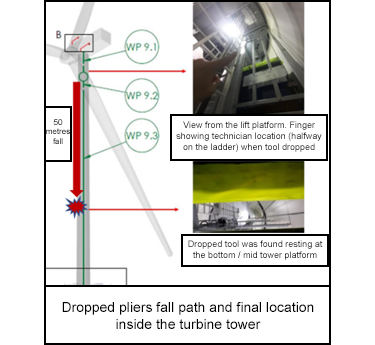
During cable installation inside the floating offshore wind turbine (FOWT) tower, a technician’s cable tie pliers, weighing 0.57 kg (1.26 lb), became stuck in the ladder, broke apart, and the handle dropped.
The dropped tool fell approximately 50 m (164 ft), landing on the top platform at the bottom–middle tower section interface.
No personnel were injured. Two supporting workers were positioned safely: one in the nacelle and one on the lift platform.
Permit-to-work (PTW) restrictions ensured that no other activities were ongoing in lower tower sections at the time.
-
Why did it happen?
The tool design was unsuitable for work at height, as the handle was not firmly attached to the main body and could detach when force was applied.
The pliers, secured to the technician’s harness belt, became snagged on the ladder structure during climbing.
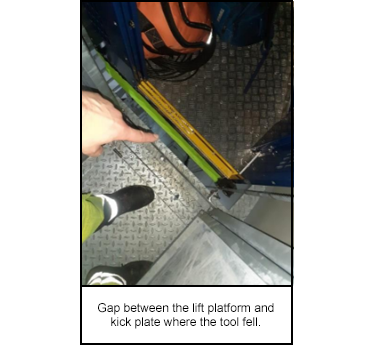
A small gap between the lift platform and the kick plate allowed the tool to fall through.

-
What did they learn?
Tools used at height should be of a safe design, securely tethered and inspected before use to prevent detachment or failure.
Tools should be transported safely in tool holders or bags when climbing ladders, or lifted separately using lifting bags.
Workstations and access points at height should be assessed for dropped object risks, and design improvements, such as closing platform gaps, should be considered.
Permit-to-work systems, safety barriers, and restricted access are essential to prevent people working or passing below dropped object hazards.
Ongoing training and awareness are critical to ensure workers understand and consistently apply dropped object prevention measures.

-
Ask yourself or your crew
Are all tools to be used at height of a safe design, tethered and inspected for secure attachment?
How will tools be transported while climbing ladders?
Have the workstations, platforms, and access points been assessed for dropped object risks?
Is the permit-to-work system in place?
Add to homescreen
Content name
Select existing category:
Content name
New collection
Edit collection

What happened?
During cable installation inside the floating offshore wind turbine (FOWT) tower, a technician’s cable tie pliers, weighing 0.57 kg (1.26 lb), became stuck in the ladder, broke apart, and the handle dropped.
The dropped tool fell approximately 50 m (164 ft), landing on the top platform at the bottom–middle tower section interface.
No personnel were injured. Two supporting workers were positioned safely: one in the nacelle and one on the lift platform.
Permit-to-work (PTW) restrictions ensured that no other activities were ongoing in lower tower sections at the time.

Why did it happen?
The tool design was unsuitable for work at height, as the handle was not firmly attached to the main body and could detach when force was applied.
The pliers, secured to the technician’s harness belt, became snagged on the ladder structure during climbing.
A small gap between the lift platform and the kick plate allowed the tool to fall through.

What did they learn?
Tools used at height should be of a safe design, securely tethered and inspected before use to prevent detachment or failure.
Tools should be transported safely in tool holders or bags when climbing ladders, or lifted separately using lifting bags.
Workstations and access points at height should be assessed for dropped object risks, and design improvements, such as closing platform gaps, should be considered.
Permit-to-work systems, safety barriers, and restricted access are essential to prevent people working or passing below dropped object hazards.
Ongoing training and awareness are critical to ensure workers understand and consistently apply dropped object prevention measures.

Ask yourself or your crew
Are all tools to be used at height of a safe design, tethered and inspected for secure attachment?
How will tools be transported while climbing ladders?
Have the workstations, platforms, and access points been assessed for dropped object risks?
Is the permit-to-work system in place?
Cable tie pliers snagged on a turbine ladder, broke apart and fell 50m (160 ft) during a cable installation.