-
What happened?
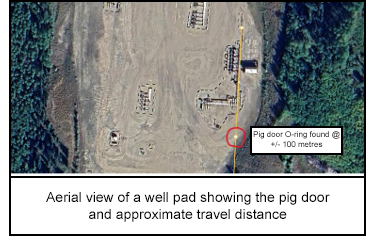
A pig was ejected through a closed pig barrel door and travelled over 100 metres (328 feet) across a well pad, over process piping.
Approximately one hour after partially clearing a hydrate at a pig receiver, Operations launched a pig from a well pad towards the same pig receiver where the hydrate was recently thought to be cleared.
The remaining hydrate at the pig receiver prevented the pig from entering the pig receiver when it should have arrived later that day.
The pig, combined with the remaining hydrate, was sufficient to block flow from the well pad, resulting in a pressure differential of approximately 2,500 kilopascals (363 pounds per square inch) across the pig.
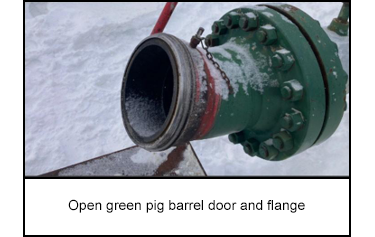
While Operations was diagnosing the cause of the pressure increase at the pig receiver location, the hydrate released and the pig was ejected through the closed pig barrel door.
-
Why did it happen?
Conditions at the pig receiver riser were conducive to hydrate formation.
Targeted methanol injection rates were not clearly or formally documented.
Hydrate management and pigging procedures allowed for interpretation.
Actions taken were consistent with the field team’s understanding that hydrate risk was being managed.
Decision points for stopping, depressurising or verifying hydrate clearance relied on individual judgement.
-
What did they learn?
Document when and where hydrates are observed in operational systems so they can be tracked and field supervisors can initiate remedial action as required.
Strengthen the effectiveness of hydrate field-level assessments.
Implement controls to ensure hydrate dissipation activities are adequately assessed and planned.
Document locations where process equipment is in the line of fire of pig receivers and assess mitigation options, for example protective barriers.
Provide minimum methanol injection guidelines for pipelines and review rates following the next set of monthly rounds.
Investigate and field-test factors contributing to hydrate formation, for example methanol rates and piping geometry, and apply learnings and methodology to other hydrate-prone pipelines.
Document limitations of pig barrel doors in pigging and pipeline hydrate documentation.
Evaluate the effectiveness of existing pig barrel inspection practices.
Share pig receiver and process equipment line of fire findings with Operations and Projects teams to ensure pig barrel orientation is considered in new projects and in the siting of temporary trailers and facilities.

-
Ask yourself or your crew
How effective are hydrate controls in your operations?
Where in your operations are people or assets located that are in the line of fire, and what protective barriers need to be in place?
Are line of fire risks in relation to pig barrel orientation considered during facility design and construction?
How do we know the risk controls and barriers for hydrate dissipation and pigging are working?

Add to homescreen
Content name
Select existing category:
Content name
New collection
Edit collection

What happened?
A pig was ejected through a closed pig barrel door and travelled over 100 metres (328 feet) across a well pad, over process piping.
Approximately one hour after partially clearing a hydrate at a pig receiver, Operations launched a pig from a well pad towards the same pig receiver where the hydrate was recently thought to be cleared.
The remaining hydrate at the pig receiver prevented the pig from entering the pig receiver when it should have arrived later that day.
The pig, combined with the remaining hydrate, was sufficient to block flow from the well pad, resulting in a pressure differential of approximately 2,500 kilopascals (363 pounds per square inch) across the pig.
While Operations was diagnosing the cause of the pressure increase at the pig receiver location, the hydrate released and the pig was ejected through the closed pig barrel door.

Why did it happen?
Conditions at the pig receiver riser were conducive to hydrate formation.
Targeted methanol injection rates were not clearly or formally documented.
Hydrate management and pigging procedures allowed for interpretation.
Actions taken were consistent with the field team’s understanding that hydrate risk was being managed.
Decision points for stopping, depressurising or verifying hydrate clearance relied on individual judgement.

What did they learn?
Document when and where hydrates are observed in operational systems so they can be tracked and field supervisors can initiate remedial action as required.
Strengthen the effectiveness of hydrate field-level assessments.
Implement controls to ensure hydrate dissipation activities are adequately assessed and planned.
Document locations where process equipment is in the line of fire of pig receivers and assess mitigation options, for example protective barriers.
Provide minimum methanol injection guidelines for pipelines and review rates following the next set of monthly rounds.
Investigate and field-test factors contributing to hydrate formation, for example methanol rates and piping geometry, and apply learnings and methodology to other hydrate-prone pipelines.
Document limitations of pig barrel doors in pigging and pipeline hydrate documentation.
Evaluate the effectiveness of existing pig barrel inspection practices.
Share pig receiver and process equipment line of fire findings with Operations and Projects teams to ensure pig barrel orientation is considered in new projects and in the siting of temporary trailers and facilities.

Ask yourself or your crew
How effective are hydrate controls in your operations?
Where in your operations are people or assets located that are in the line of fire, and what protective barriers need to be in place?
Are line of fire risks in relation to pig barrel orientation considered during facility design and construction?
How do we know the risk controls and barriers for hydrate dissipation and pigging are working?
A hydrate blockage created a pressure differential and a pig was ejected through a closed pig barrel door.
Original material courtesy of Energy Safety Canada