-
What happened?
During the energisation of a wind turbine string, a technical supervisor observed low voltage readings on three turbines.
The issue was immediately reported to high-voltage (HV) control, and breakers were opened within 10 minutes of spotting the error.
No personnel were exposed due to an exclusion zone in place for first energisation.
All equipment had passed high-voltage testing and inspection prior to the event and no damage occurred, but the situation was classified as a near miss.

-
Why did it happen?
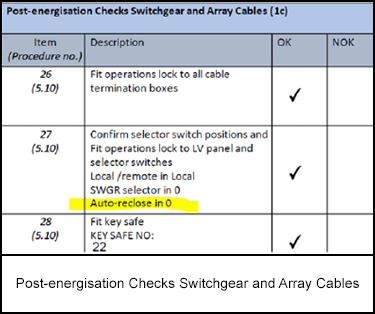
The post-energisation checklist included incorrect guidance regarding the auto-reclose switch.
The switch type was spring-loaded and returned to the 0 position regardless of command
The technician did not account for the switch’s behaviour, leading to unintended breaker closure.
The checklist failed to specify that the switch must be set to “OFF” and confirmed via relay.
The disconnector was not open, allowing the circuit breaker to auto-reclose.
-
What did they learn?
Procedures must be updated to reflect the actual behaviour of system components.
Technicians should be trained to understand the specific types of switches and relays used.
Confirmation of switch status must be done via reliable indicators like relays.
Energisation checklists should be reviewed and validated for accuracy.
Exclusion zones remain a critical control for protecting personnel during energisation.

-
Ask yourself or your crew
Are our energisation procedures aligned with the actual equipment configurations?
How do we verify switch positions and relay statuses before energising systems?
What training do we provide on interpreting Supervisory control and data acquisition (SCADA) and switchgear behaviour?
Are checklists regularly reviewed and updated based on field feedback?
How can we improve communication between field technicians and HV control?

Add to homescreen
Content name
Select existing category:
Content name
New collection
Edit collection

What happened?
During the energisation of a wind turbine string, a technical supervisor observed low voltage readings on three turbines.
The issue was immediately reported to high-voltage (HV) control, and breakers were opened within 10 minutes of spotting the error.
No personnel were exposed due to an exclusion zone in place for first energisation.
All equipment had passed high-voltage testing and inspection prior to the event and no damage occurred, but the situation was classified as a near miss.

Why did it happen?
The post-energisation checklist included incorrect guidance regarding the auto-reclose switch.
The switch type was spring-loaded and returned to the 0 position regardless of command
The technician did not account for the switch’s behaviour, leading to unintended breaker closure.
The checklist failed to specify that the switch must be set to “OFF” and confirmed via relay.
The disconnector was not open, allowing the circuit breaker to auto-reclose.

What did they learn?
Procedures must be updated to reflect the actual behaviour of system components.
Technicians should be trained to understand the specific types of switches and relays used.
Confirmation of switch status must be done via reliable indicators like relays.
Energisation checklists should be reviewed and validated for accuracy.
Exclusion zones remain a critical control for protecting personnel during energisation.

Ask yourself or your crew
Are our energisation procedures aligned with the actual equipment configurations?
How do we verify switch positions and relay statuses before energising systems?
What training do we provide on interpreting Supervisory control and data acquisition (SCADA) and switchgear behaviour?
Are checklists regularly reviewed and updated based on field feedback?
How can we improve communication between field technicians and HV control?
Low turbine voltage was spotted and HV control opened breakers within 10 minutes. No one was exposed and no equipment was damaged, but it was a near miss.