-
What happened?
During turbine commissioning at an offshore site, a genset refuelling operation was performed prior to energisation.
After confirmation that the turbine was locked and secured, a service vessel transferred the fuel cell to the foundation platform in a first lift.
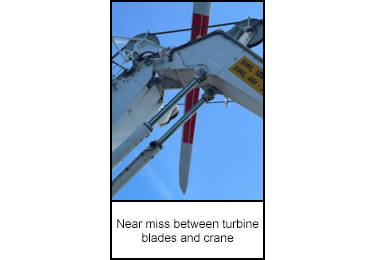
During the operation, the turbine blades unexpectedly started turning, approaching the vessel’s crane boom prepared for a second lift.
Vessel officers quickly reacted by taking manual control and applying full thrust forward, avoiding any contact with the crane.
-
Why did it happen?
The turbine was not energised, so the nacelle could not be positioned to keep the blades away from the vessel during refuelling.
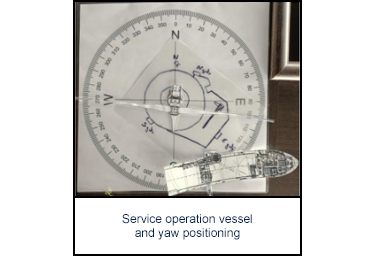
The vessel’s heading and turbine orientation were misaligned due to current and operational constraints, and refuelling was required.
Miscommunication occurred between the installation lead, contractor marine coordination, and vessel regarding the actual status of the turbine and rotor lock.
-
What did they learn?
The contractor transfer procedure was not distributed or clearly understood by all stakeholders.
The nacelle heading and vessel approach were not optimally planned, creating a potential clash.
The communication chain was overly complex, causing misunderstandings between the installation lead, vessel bridge, and marine coordination.
There was terminology confusion, where ‘rotor lock’ was mistaken for ‘yaw lock’, leading to incorrect assumptions about turbine status.

-
Ask yourself or your crew
How can we make sure all stakeholders understand the transfer and refuelling procedures?
How can we plan vessel approach and nacelle position to avoid clashes?
How can we simplify communication between the installation lead, vessel bridge, and marine coordination?
How can we clarify key terms like rotor lock vs. yaw lock for everyone?
How can we better confirm turbine status before offshore operations?

Add to homescreen
Content name
Select existing category:
Content name
New collection
Edit collection

What happened?
During turbine commissioning at an offshore site, a genset refuelling operation was performed prior to energisation.
After confirmation that the turbine was locked and secured, a service vessel transferred the fuel cell to the foundation platform in a first lift.
During the operation, the turbine blades unexpectedly started turning, approaching the vessel’s crane boom prepared for a second lift.
Vessel officers quickly reacted by taking manual control and applying full thrust forward, avoiding any contact with the crane.

Why did it happen?
The turbine was not energised, so the nacelle could not be positioned to keep the blades away from the vessel during refuelling.
The vessel’s heading and turbine orientation were misaligned due to current and operational constraints, and refuelling was required.
Miscommunication occurred between the installation lead, contractor marine coordination, and vessel regarding the actual status of the turbine and rotor lock.

What did they learn?
The contractor transfer procedure was not distributed or clearly understood by all stakeholders.
The nacelle heading and vessel approach were not optimally planned, creating a potential clash.
The communication chain was overly complex, causing misunderstandings between the installation lead, vessel bridge, and marine coordination.
There was terminology confusion, where ‘rotor lock’ was mistaken for ‘yaw lock’, leading to incorrect assumptions about turbine status.

Ask yourself or your crew
How can we make sure all stakeholders understand the transfer and refuelling procedures?
How can we plan vessel approach and nacelle position to avoid clashes?
How can we simplify communication between the installation lead, vessel bridge, and marine coordination?
How can we clarify key terms like rotor lock vs. yaw lock for everyone?
How can we better confirm turbine status before offshore operations?
A turbine unexpectedly started rotating during offshore refuelling, creating a near miss with a vessel crane.