-
What happened?
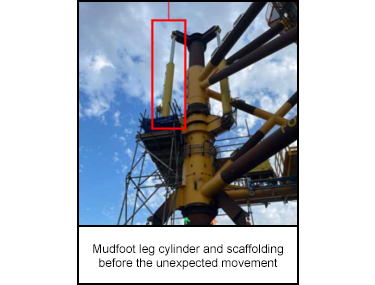
During planned maintenance, a position transducer was being replaced on mudfoot leg 3 of a drilling leader tower (DLT).
Scaffolding was erected on the mudfoot, and chain blocks were installed to secure it.
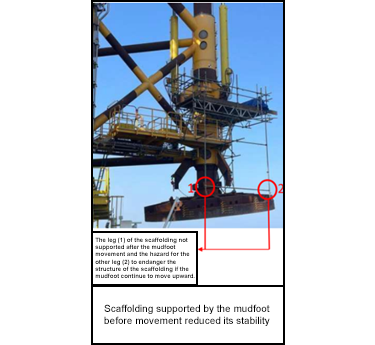
Unexpected movement of all three cylinders caused one chain block to fail, resulting in the mudfoot leaning towards the vessel and the scaffolding losing stability.
The maintenance team promptly evacuated to a safe area because of the risk of further movement.
-
Why did it happen?
Hydraulic check valves failed, causing unintended cylinder movement.
Lifting gear was underrated, with a 3.5-tonne (7,716 lb) safe working load (SWL) instead of the required 10 tonnes (22,046 lb).
Inadequate shift communication led to incorrect rigging application during preparation.
Scaffolding legs placed on the mudfoot increased stability initially but created a hazard once the mudfoot shifted.
-
What did they learn?
Critical equipment, including scaffolding, rigging, hydraulic systems, should be properly rated, inspected, and supported with additional controls to prevent uncontrolled movement.
Clear communication of method statements and thorough shift handovers are essential to avoid misapplication of rigging or procedures.
Using mechanical locks, tensioned rigging, and enhanced isolation, such as extra check valves, significantly reduces risks during maintenance on moving structures.

-
Ask yourself or your crew
How do we verify that all lifting and rigging equipment being used has the correct SWL and has been inspected before the task?
What steps ensure that method statements and lock-out/tag-out (LOTO) requirements are clearly communicated and understood during every shift handover?
How can we design scaffolding and access methods so they remain stable if there is unexpected movement?
What additional hydraulic isolation or mechanical locking measures should be in place before starting similar maintenance?

Add to homescreen
Content name
Select existing category:
Content name
New collection
Edit collection

What happened?
During planned maintenance, a position transducer was being replaced on mudfoot leg 3 of a drilling leader tower (DLT).
Scaffolding was erected on the mudfoot, and chain blocks were installed to secure it.
Unexpected movement of all three cylinders caused one chain block to fail, resulting in the mudfoot leaning towards the vessel and the scaffolding losing stability.
The maintenance team promptly evacuated to a safe area because of the risk of further movement.

Why did it happen?
Hydraulic check valves failed, causing unintended cylinder movement.
Lifting gear was underrated, with a 3.5-tonne (7,716 lb) safe working load (SWL) instead of the required 10 tonnes (22,046 lb).
Inadequate shift communication led to incorrect rigging application during preparation.
Scaffolding legs placed on the mudfoot increased stability initially but created a hazard once the mudfoot shifted.

What did they learn?
Critical equipment, including scaffolding, rigging, hydraulic systems, should be properly rated, inspected, and supported with additional controls to prevent uncontrolled movement.
Clear communication of method statements and thorough shift handovers are essential to avoid misapplication of rigging or procedures.
Using mechanical locks, tensioned rigging, and enhanced isolation, such as extra check valves, significantly reduces risks during maintenance on moving structures.

Ask yourself or your crew
How do we verify that all lifting and rigging equipment being used has the correct SWL and has been inspected before the task?
What steps ensure that method statements and lock-out/tag-out (LOTO) requirements are clearly communicated and understood during every shift handover?
How can we design scaffolding and access methods so they remain stable if there is unexpected movement?
What additional hydraulic isolation or mechanical locking measures should be in place before starting similar maintenance?
A mudfoot leg moved unexpectedly during planned maintenance, causing rigging failure and loss of scaffold stability.