-
What happened?
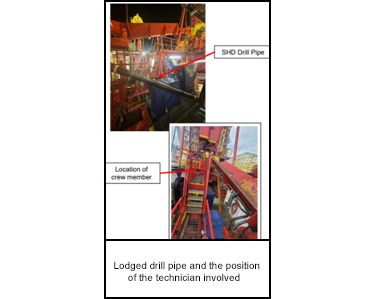
While retrieving a 4-metre (13-foot) length of drill pipe from a borehole, the piece of drill, weighing around 250 kg (551 lbs), became lodged in the pipe handling equipment.
Technicians on board devised an improvised way of retrieving the drill using a tail winch and nylon straps.
A technician used a crowbar to dislodge the drill piece and as it was loosened, the rigging failed and the piece fell to the deck below.
Works were stopped and the dayshift project manager was informed of the incident.
-
Why did it happen?
A full risk assessment was not performed.
The correct equipment was not used to retrieve the pipe as the retrieval operation was arranged in the moment.
It was discovered that task risk assessments were not fit for purpose. An update was made and communicated to all technicians.

-
What did they learn?
It was discovered that the automatic pipe retrieval system was not compatible with the diameter of drill being used in this operation. This was also not picked up on in the management of change process.
The operation was carried out by a single technician operating both the crowbar and the winch sequentially. An operation like this would normally be carried out by two or more technicians simultaneously.
A full refit of the pipe handling extension piece was performed to make sure it could handle the correct pipe size in the future.

-
Ask yourself or your crew
Are the correct tools being used for the job at hand?
Do all the tools/equipment pass compatibility tests for the tasks being done?
Are there enough people on hand to help in case of a change in circumstance?
What is the “plan b” in place in case of a change in circumstance when completing a job?
Has a change of work process been carried out properly?

Add to homescreen
Content name
Select existing category:
Content name
New collection
Edit collection

What happened?
While retrieving a 4-metre (13-foot) length of drill pipe from a borehole, the piece of drill, weighing around 250 kg (551 lbs), became lodged in the pipe handling equipment.
Technicians on board devised an improvised way of retrieving the drill using a tail winch and nylon straps.
A technician used a crowbar to dislodge the drill piece and as it was loosened, the rigging failed and the piece fell to the deck below.
Works were stopped and the dayshift project manager was informed of the incident.

Why did it happen?
A full risk assessment was not performed.
The correct equipment was not used to retrieve the pipe as the retrieval operation was arranged in the moment.
It was discovered that task risk assessments were not fit for purpose. An update was made and communicated to all technicians.

What did they learn?
It was discovered that the automatic pipe retrieval system was not compatible with the diameter of drill being used in this operation. This was also not picked up on in the management of change process.
The operation was carried out by a single technician operating both the crowbar and the winch sequentially. An operation like this would normally be carried out by two or more technicians simultaneously.
A full refit of the pipe handling extension piece was performed to make sure it could handle the correct pipe size in the future.

Ask yourself or your crew
Are the correct tools being used for the job at hand?
Do all the tools/equipment pass compatibility tests for the tasks being done?
Are there enough people on hand to help in case of a change in circumstance?
What is the “plan b” in place in case of a change in circumstance when completing a job?
Has a change of work process been carried out properly?
A drill pipe section became lodged and fell during an improvised retrieval attempt, dropping to the deck after rigging failed.