-
What happened?
During a night shift, a team was assembling an external staircase on a wind power vessel.
A section of stairs was being removed and secured, following work instructions.
Conflicting guidance led to uncertainty about how many people were needed for comfortable lifting of the stair section.
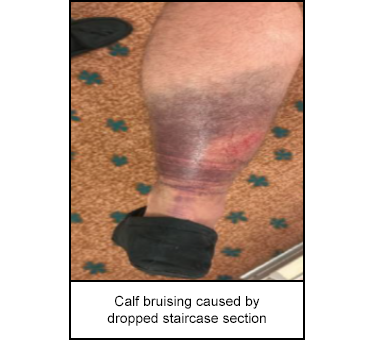
The section dropped unexpectedly, injuring two individuals.
One technician was struck on the calf, and another person nearby was hit on the foot.
-
Why did it happen?
Work instructions contained conflicting information about load handling requirements, and the task involved heavier components than described in the documentation.
A known discrepancy in weight was reported in a non-conformance report but not corrected in the statement of work.
A lack of clarity led to inadequate personnel allocation for the task and resulted in improper handling and insufficient safeguards.

-
What did they learn?
Ensure all work instructions are accurate and reflect actual site conditions.
Address non-conformance reports promptly and update documentation accordingly.
Conduct thorough risk assessments and verify personnel competency.
Communicate clearly about task requirements, especially for lifting operations.
Review outstanding safety issues regularly and resolve them before continuing work.

-
Ask yourself or your crew
Are our work instructions clear and up to date for all tasks?
How do we ensure non-conformance reports lead to timely action?
What checks do we have in place for manual lifting and rigging tasks?
How do we verify that the correct number of people are assigned to a task?
What would we do differently to prevent a dropped load incident?

Add to homescreen
Content name
Select existing category:
Content name
New collection
Edit collection

What happened?
During a night shift, a team was assembling an external staircase on a wind power vessel.
A section of stairs was being removed and secured, following work instructions.
Conflicting guidance led to uncertainty about how many people were needed for comfortable lifting of the stair section.
The section dropped unexpectedly, injuring two individuals.
One technician was struck on the calf, and another person nearby was hit on the foot.

Why did it happen?
Work instructions contained conflicting information about load handling requirements, and the task involved heavier components than described in the documentation.
A known discrepancy in weight was reported in a non-conformance report but not corrected in the statement of work.
A lack of clarity led to inadequate personnel allocation for the task and resulted in improper handling and insufficient safeguards.

What did they learn?
Ensure all work instructions are accurate and reflect actual site conditions.
Address non-conformance reports promptly and update documentation accordingly.
Conduct thorough risk assessments and verify personnel competency.
Communicate clearly about task requirements, especially for lifting operations.
Review outstanding safety issues regularly and resolve them before continuing work.

Ask yourself or your crew
Are our work instructions clear and up to date for all tasks?
How do we ensure non-conformance reports lead to timely action?
What checks do we have in place for manual lifting and rigging tasks?
How do we verify that the correct number of people are assigned to a task?
What would we do differently to prevent a dropped load incident?
Conflicting lifting guidance during staircase assembly on a wind power vessel led to a dropped stair section, injuring two workers.