-
What happened?
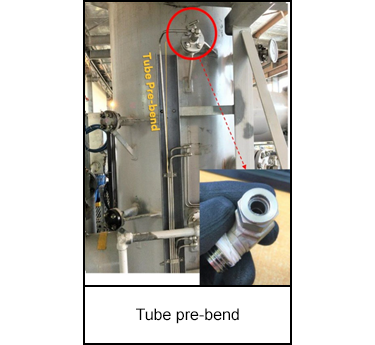
Failed instrument tubing failed on a compressor at a gas processing facility resulting in a full-bore release of low-pressure hydrocarbon gas (methane) via the open-ended instrument fitting.
Gas continued to vent from the open fitting via a passing inlet shutdown valve for approximately 4 hours.
This resulted in a Tier 2 loss of containment (approximately 240kg (529lbs) released at about 60kg/hr (132lbs/hr)).
The reduction in pressure to the instrument activated the low suction pressure alarm which initiated a controlled shutdown of the machine.
A field operator attempted restarting the compressor twice prior to contacting a technician.
The technician identified the broken Swagelok instrument tube and closed the local instrument isolation valve.
-
Why did it happen?
Design and installation: Tubing installation (routing and supports) was not in accordance with Tubing specifications and good industry practice. The fitting was statically strained (bent into place to fit) resulting in additional loading on the fitting. Inadequate support (using metallic supports that are unsuitable for vibrating service) and limited flexibility of tubing in vibrating service (too stiff) directly led to the failure.
Gas detection system: Both fixed and portable gas detection systems failed to identify the Tier 2 hydrocarbon gas release.

-
What did they learn?
Gas detection system:
- Fixed gas detectors did not activate as the gas cloud was too small (readily dispersed). Fixed gas detectors are designed for larger volume releases (to avoid spurious alarms/trips).
- The personal gas detector worn by the Field operator did not activate during the compressor walk around conducted before attempting to restart the machine. The leak occurred at height (above head level), and personal gas detectors are generally worn on the chest. Methane is neutrally, or slightly positively buoyant and there was good ventilation. Small gas releases may not activate personal gas detectors during a compressor walk around.
- The low suction pressure triggered a controlled shutdown (not an emergency shutdown). This closes the inlet shutdown valve (SDV) but does not vent the machine. The closed SDV passes at a low rate (less than Tier 2 release rate but greater than American Petroleum Institute (API) accepted valve leakage specifications). This continued to pressure the machine and resulted in an extended period of venting methane via the broken tube. SDVs require maintenance to improve leak tightness.
Small bore tubing in vibrating service:
- Where possible, eliminate small bore hydrocarbon tubing in high vibrating service.
- Tubing in vibrating service (where required) should be sufficiently “flexible” and well supported. Tube routing should meet the Energy Institute Guidelines for flexibility in two planes.
- Tubing should not be bent or forced into place. Proactively remove metallic clamps and upgrade to clamps suitable for vibrating service.
- Vibration measurement surveys are not generally used to assess tubing vibration (they are focused on compressor, vessels and piping). Attaching an accelerometer to the tubing alters the frequency and system response. It is also recognised that tubing is designed to be flexible, so vibration monitoring may not be suitable/practicable. Visual inspection is the best strategy for tubing integrity verification.
- Reciprocating compressors generally have higher vibration levels than screw/centrifugal compressors.

-
Ask yourself or your crew
Do you have small bore hydrocarbon tubing at your site? Is it in vibrating service? Are you aware that gas leaking from small bore tubing may not be picked up by your personal gas detection monitor? Do you know what to do if you suspect that gas might be leaking from small bore tubing?
Are you involved in installing or inspecting small bore tubing that is in vibrating service? Are you familiar with good industry practice relating to small bore tubing? Do your inspection checklists reflect good industry practice? Have you received training in: tube routing for flexibility; reduction of static stresses; sufficient spacing of supports; and suitability of clamps for vibrating service?
Add to homescreen
Content name
Select existing category:
Content name
New collection
Edit collection

What happened?
Failed instrument tubing failed on a compressor at a gas processing facility resulting in a full-bore release of low-pressure hydrocarbon gas (methane) via the open-ended instrument fitting.
Gas continued to vent from the open fitting via a passing inlet shutdown valve for approximately 4 hours.
This resulted in a Tier 2 loss of containment (approximately 240kg (529lbs) released at about 60kg/hr (132lbs/hr)).
The reduction in pressure to the instrument activated the low suction pressure alarm which initiated a controlled shutdown of the machine.
A field operator attempted restarting the compressor twice prior to contacting a technician.
The technician identified the broken Swagelok instrument tube and closed the local instrument isolation valve.

Why did it happen?
Design and installation: Tubing installation (routing and supports) was not in accordance with Tubing specifications and good industry practice. The fitting was statically strained (bent into place to fit) resulting in additional loading on the fitting. Inadequate support (using metallic supports that are unsuitable for vibrating service) and limited flexibility of tubing in vibrating service (too stiff) directly led to the failure.
Gas detection system: Both fixed and portable gas detection systems failed to identify the Tier 2 hydrocarbon gas release.

What did they learn?
Gas detection system:
- Fixed gas detectors did not activate as the gas cloud was too small (readily dispersed). Fixed gas detectors are designed for larger volume releases (to avoid spurious alarms/trips).
- The personal gas detector worn by the Field operator did not activate during the compressor walk around conducted before attempting to restart the machine. The leak occurred at height (above head level), and personal gas detectors are generally worn on the chest. Methane is neutrally, or slightly positively buoyant and there was good ventilation. Small gas releases may not activate personal gas detectors during a compressor walk around.
- The low suction pressure triggered a controlled shutdown (not an emergency shutdown). This closes the inlet shutdown valve (SDV) but does not vent the machine. The closed SDV passes at a low rate (less than Tier 2 release rate but greater than American Petroleum Institute (API) accepted valve leakage specifications). This continued to pressure the machine and resulted in an extended period of venting methane via the broken tube. SDVs require maintenance to improve leak tightness.
Small bore tubing in vibrating service:
- Where possible, eliminate small bore hydrocarbon tubing in high vibrating service.
- Tubing in vibrating service (where required) should be sufficiently “flexible” and well supported. Tube routing should meet the Energy Institute Guidelines for flexibility in two planes.
- Tubing should not be bent or forced into place. Proactively remove metallic clamps and upgrade to clamps suitable for vibrating service.
- Vibration measurement surveys are not generally used to assess tubing vibration (they are focused on compressor, vessels and piping). Attaching an accelerometer to the tubing alters the frequency and system response. It is also recognised that tubing is designed to be flexible, so vibration monitoring may not be suitable/practicable. Visual inspection is the best strategy for tubing integrity verification.
- Reciprocating compressors generally have higher vibration levels than screw/centrifugal compressors.

Ask yourself or your crew
Do you have small bore hydrocarbon tubing at your site? Is it in vibrating service? Are you aware that gas leaking from small bore tubing may not be picked up by your personal gas detection monitor? Do you know what to do if you suspect that gas might be leaking from small bore tubing?
Are you involved in installing or inspecting small bore tubing that is in vibrating service? Are you familiar with good industry practice relating to small bore tubing? Do your inspection checklists reflect good industry practice? Have you received training in: tube routing for flexibility; reduction of static stresses; sufficient spacing of supports; and suitability of clamps for vibrating service?
Failed instrument tubing caused a 240kg (529lbs) methane release, triggering compressor shutdown and delayed isolation of the gas source.
Original material courtesy of Safer Together (Australia)
To access the PDF and PowerPoint versions, please visit https://www.safertogether.com.au/learning-event-bulletins/operating-process-equipment-loss-of-containment-jul-2024