-
What happened?
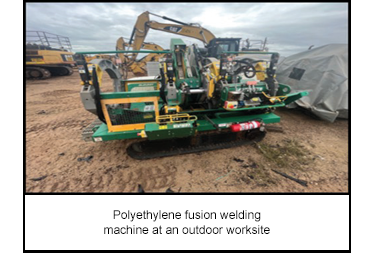
A worker sustained fatal injuries while working on a polyethylene fusion welding machine.
While reaching out to adjust the lifting sling on the piece of pipe in the machine, the worker’s body was placed between the hydraulic pipe lift and the tie bar.
The machine’s control levers were accidentally activated during this time, leading to fatal injuries.
-
Why did it happen?
Polyethylene fusion welding machines are used for work conducted on newly installed gathering pipelines and repairs to existing pipelines.
The work being undertaken at the time of the incident was to join a low-point drain to existing pipework.
When moving polyethylene pipe in and out of this machine, operators are required to use a sling to assist with lifting the pipe out of the machine.
The machine being used at the time of the incident was energised.
The control levers on the machine were not isolated. The machine did not have a mechanism to isolate the hydraulic system, which was the energy source for the control levers.
The control levers on the machine were not shrouded to prevent accidental activation.
The piece of pipe on the machine had a lifting sling around it.

-
What did they learn?
Following this incident, all operations using fusion welding machines were halted, and an investigation was conducted to identify controls that could prevent the incident from recurring.
Operations with polyethylene fusion welding machines recommenced once the identified controls were implemented. The controls remain in place and include:
Engineering controls: guarding installed in the crush zone; dual activation levers for hydraulic systems; and an isolation device for hydraulic systems.
Administrative controls: plant risk assessments reviewed to ensure risks of accidental activation and crush points are sufficiently captured; safe work method statements updated to capture the risk of potential crush points; and safety leadership to allow everyone to lead safety conversations.
Understand and use safety-critical equipment and procedures that apply to the task.
Obtain authorisation before disabling or overriding safety equipment or deviating from procedures.
Identify all energy sources. Check there is zero energy and test for residual or stored energy.
Be positioned to avoid moving objects. Establish and obey barriers.
Confirm that hazards are controlled and it is safe to start. Stop and reassess if conditions change.
-
Ask yourself or your crew
How are we checking and assuring that polyethylene fusion welding machines have guarding and other engineering controls in place?
Do the risk assessments completed on plant and machinery address the risk of accidental activation?
Does the training completed by workers using this machine cover crush-point hazards?
Are we reviewing advances in technology for new machinery used for fast fusion welding activities?
Add to homescreen
Content name
Select existing category:
Content name
New collection
Edit collection

What happened?
A worker sustained fatal injuries while working on a polyethylene fusion welding machine.
While reaching out to adjust the lifting sling on the piece of pipe in the machine, the worker’s body was placed between the hydraulic pipe lift and the tie bar.
The machine’s control levers were accidentally activated during this time, leading to fatal injuries.

Why did it happen?
Polyethylene fusion welding machines are used for work conducted on newly installed gathering pipelines and repairs to existing pipelines.
The work being undertaken at the time of the incident was to join a low-point drain to existing pipework.
When moving polyethylene pipe in and out of this machine, operators are required to use a sling to assist with lifting the pipe out of the machine.
The machine being used at the time of the incident was energised.
The control levers on the machine were not isolated. The machine did not have a mechanism to isolate the hydraulic system, which was the energy source for the control levers.
The control levers on the machine were not shrouded to prevent accidental activation.
The piece of pipe on the machine had a lifting sling around it.

What did they learn?
Following this incident, all operations using fusion welding machines were halted, and an investigation was conducted to identify controls that could prevent the incident from recurring.
Operations with polyethylene fusion welding machines recommenced once the identified controls were implemented. The controls remain in place and include:
Engineering controls: guarding installed in the crush zone; dual activation levers for hydraulic systems; and an isolation device for hydraulic systems.
Administrative controls: plant risk assessments reviewed to ensure risks of accidental activation and crush points are sufficiently captured; safe work method statements updated to capture the risk of potential crush points; and safety leadership to allow everyone to lead safety conversations.
Understand and use safety-critical equipment and procedures that apply to the task.
Obtain authorisation before disabling or overriding safety equipment or deviating from procedures.
Identify all energy sources. Check there is zero energy and test for residual or stored energy.
Be positioned to avoid moving objects. Establish and obey barriers.
Confirm that hazards are controlled and it is safe to start. Stop and reassess if conditions change.

Ask yourself or your crew
How are we checking and assuring that polyethylene fusion welding machines have guarding and other engineering controls in place?
Do the risk assessments completed on plant and machinery address the risk of accidental activation?
Does the training completed by workers using this machine cover crush-point hazards?
Are we reviewing advances in technology for new machinery used for fast fusion welding activities?
A worker was fatally injured when hydraulic controls were accidentally activated while adjusting a pipe lifting sling.
Original material courtesy of Safer Together (Australia)
To access the PDF and PowerPoint versions, please visit https://www.safertogether.com.au/learning-event-bulletins/operating-hydraulic-equipment-person-in-line-of-fire-leb-toolbox
IOGP Life-Saving Rules: https://www.iogp.org/workstreams/safety/safety/life-savingrules/
Safer Together – Assist & Assure: https://www.safertogether.com.au/resources/products-and-programs/assist-assure
Safer Together – Line of Fire Mini-Portal: https://www.safertogether.com.au/resources/products-and-programs/line-of-fire