-
What happened?
A crew member was retrieving paint during vessel maintenance activities.
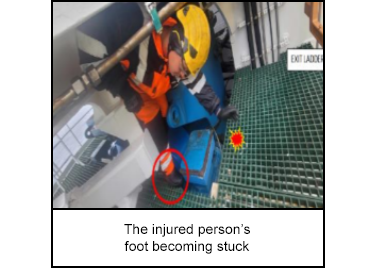
Their shoe became wedged between a drainage grating and an electric motor.
The individual then fell and extended their arm to try and break the fall.
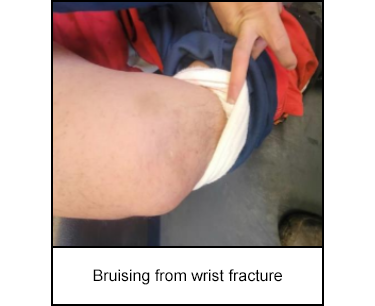
Initially, no major injury was suspected and the person returned to work.
However, a later X-ray revealed a fractured wrist, which required medical treatment.
-
Why did it happen?
No last-minute risk assessment was conducted before the task.
The passage to the paint store was narrow and poorly designed with no markings on walkways between gratings and stationary equipment.
The physical environment lacked adequate access and protection.
Operational processes failed to address hazards in cramped spaces.

-
What did they learn?
Always conduct a task-specific risk assessment, even for mundane or routine activities.
Ensure safe access routes and clearly marked walkways in all work areas.
Review and redesign cramped or narrow workspaces to reduce trip hazards and implement protective measures around open gratings and equipment.
Share learnings across teams to identify and mitigate similar risks.
-
Ask yourself or your crew
Do we have clearly defined walkways in all work areas?
How do we ensure last-minute risk assessments are completed?
What hazards exist in our current workspace layout?
How can we improve access and egress in confined or narrow areas?
What would we do differently if this incident occurred in our team?

Add to homescreen
Content name
Select existing category:
Content name
New collection
Edit collection

What happened?
A crew member was retrieving paint during vessel maintenance activities.
Their shoe became wedged between a drainage grating and an electric motor.
The individual then fell and extended their arm to try and break the fall.
Initially, no major injury was suspected and the person returned to work.
However, a later X-ray revealed a fractured wrist, which required medical treatment.

Why did it happen?
No last-minute risk assessment was conducted before the task.
The passage to the paint store was narrow and poorly designed with no markings on walkways between gratings and stationary equipment.
The physical environment lacked adequate access and protection.
Operational processes failed to address hazards in cramped spaces.

What did they learn?
Always conduct a task-specific risk assessment, even for mundane or routine activities.
Ensure safe access routes and clearly marked walkways in all work areas.
Review and redesign cramped or narrow workspaces to reduce trip hazards and implement protective measures around open gratings and equipment.
Share learnings across teams to identify and mitigate similar risks.

Ask yourself or your crew
Do we have clearly defined walkways in all work areas?
How do we ensure last-minute risk assessments are completed?
What hazards exist in our current workspace layout?
How can we improve access and egress in confined or narrow areas?
What would we do differently if this incident occurred in our team?
During vessel maintenance, a crew member tripped when their shoe became wedged and fell. A later X-ray confirmed a fractured wrist.