-
What happened?
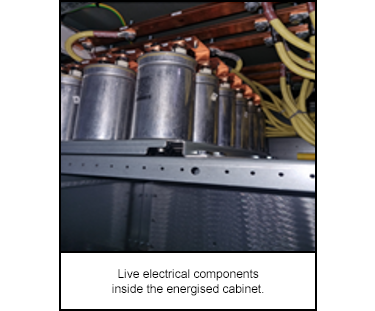
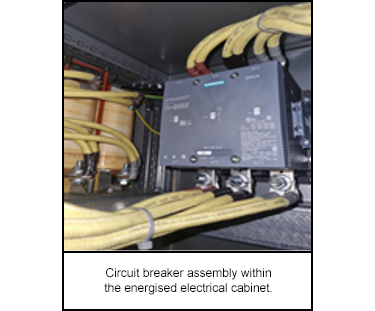
A technician accessed a live electrical cabinet to reset breakers without isolating the system or wearing appropriate personal protective equipment (PPE).
The cabinet remained energised because the technician believed power was needed for testing.
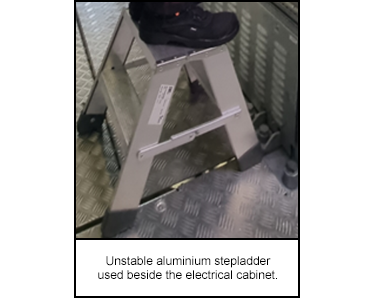
An unstable aluminium step ladder and equipment motion caused the technician to slip into the cabinet.
The technician contacted live conductors and received an electric shock.
-
Why did it happen?
The system was not isolated, and no prove-dead test was performed before removing covers, leaving live conductors exposed.
Required PPE for exposure to electrical energy was not worn during access to the cabinet.
The written procedure was ambiguous and encouraged a premature “safety achieved” sign-off, leading to the wrong step sequence being followed.
The worker believed live power was necessary for testing and skipped isolation, reflecting a human factors misjudgement.
An unstable, unsuitable access platform and equipment motion contributed to a slip into the cabinet, creating contact with energised parts.
-
What did they learn?
Ensure isolations are applied before accessing equipment; standardise and clarify procedures so isolation steps precede any safe-state declaration.
Complete the team risk dialogue at the point of work with unambiguous wording, and verify isolations through the isolation procedure, not a checkbox.
Ensure required safety documents are available at the point of work, and treat preparatory actions near energised parts as live work, applying the specified PPE.
Reinforce governance, audits, and oversight for control of hazardous energy to identify cultural drift and ensure adherence to critical safety rules.
Use the manufacturer’s fault-finding guidance alongside internal procedures, and train teams to challenge assumptions and de-energise when feasible.
-
Ask yourself or your crew
Are electrical systems isolated while you are working around them?
Is the appropriate PPE being worn by all technicians?
Are correct and appropriate safety documents available at the point of work?
Are you aware of both site guidance and manufacturer’s guidance for completing specific work tasks?
What lessons can be learned about the selection and use of access equipment when working around live or potentially live electrical systems?

Add to homescreen
Content name
Select existing category:
Content name
New collection
Edit collection

What happened?
A technician accessed a live electrical cabinet to reset breakers without isolating the system or wearing appropriate personal protective equipment (PPE).
The cabinet remained energised because the technician believed power was needed for testing.
An unstable aluminium step ladder and equipment motion caused the technician to slip into the cabinet.
The technician contacted live conductors and received an electric shock.

Why did it happen?
The system was not isolated, and no prove-dead test was performed before removing covers, leaving live conductors exposed.
Required PPE for exposure to electrical energy was not worn during access to the cabinet.
The written procedure was ambiguous and encouraged a premature “safety achieved” sign-off, leading to the wrong step sequence being followed.
The worker believed live power was necessary for testing and skipped isolation, reflecting a human factors misjudgement.
An unstable, unsuitable access platform and equipment motion contributed to a slip into the cabinet, creating contact with energised parts.

What did they learn?
Ensure isolations are applied before accessing equipment; standardise and clarify procedures so isolation steps precede any safe-state declaration.
Complete the team risk dialogue at the point of work with unambiguous wording, and verify isolations through the isolation procedure, not a checkbox.
Ensure required safety documents are available at the point of work, and treat preparatory actions near energised parts as live work, applying the specified PPE.
Reinforce governance, audits, and oversight for control of hazardous energy to identify cultural drift and ensure adherence to critical safety rules.
Use the manufacturer’s fault-finding guidance alongside internal procedures, and train teams to challenge assumptions and de-energise when feasible.

Ask yourself or your crew
Are electrical systems isolated while you are working around them?
Is the appropriate PPE being worn by all technicians?
Are correct and appropriate safety documents available at the point of work?
Are you aware of both site guidance and manufacturer’s guidance for completing specific work tasks?
What lessons can be learned about the selection and use of access equipment when working around live or potentially live electrical systems?
A technician received an electric shock after accessing a live cabinet to reset breakers without first isolating the system.