-
What happened?
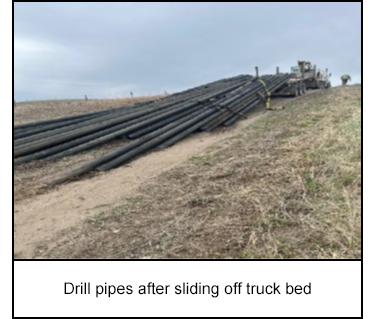
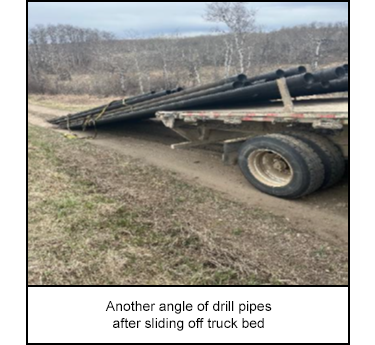
A truck was leaving a drilling location with its first load of drill pipe. Site egress involved navigating a slope. As the truck exited the lease, the load shifted and the drill pipe slid off the truck bed.
The pipe jammed into the ground as it slid backward, preventing the load from fully leaving the truck bed.
The driver immediately noticed the load shifting and stopped the truck. This quick action likely prevented the pipe fully leaving the truck bed and rolling back toward the lease, where there was the potential for serious injuries or equipment damage.

-
Why did it happen?
The investigation identified that the load was incorrectly secured. Specifically, there was no belly wrap, teething or 4x4 dunnage used to properly secure the pipe.

-
What did they learn?
The load was not secured according to pipe transport industry best practices.
4x4 dunnage was available on site, but was not used.
Time pressure - due to the rig move - was identified as a primary influence in the decision to skip belly wrap and teething.
The slope was a major factor in the load shifting, although proper securement would have prevented movement.
The pipe was dirty and greasy from recent drilling activity, but again, proper load securement would have mitigated the risk.
It was unclear how often belly wraps and 4x4 dunnage were being omitted during pipe transport.
-
Ask yourself or your crew
Do your crews have the time and resources to secure loads using industry best practices?
Are you accessing lease sites through challenging terrain? Does this affect your load securement strategy?
How are you monitoring loads for movement or shifting during transport?
What additional steps can you take to reduce the risk of losing a load on a resource road or public highway?
Add to homescreen
Content name
Select existing category:
Content name
New collection
Edit collection

What happened?
A truck was leaving a drilling location with its first load of drill pipe. Site egress involved navigating a slope. As the truck exited the lease, the load shifted and the drill pipe slid off the truck bed.
The pipe jammed into the ground as it slid backward, preventing the load from fully leaving the truck bed.
The driver immediately noticed the load shifting and stopped the truck. This quick action likely prevented the pipe fully leaving the truck bed and rolling back toward the lease, where there was the potential for serious injuries or equipment damage.

Why did it happen?
The investigation identified that the load was incorrectly secured. Specifically, there was no belly wrap, teething or 4x4 dunnage used to properly secure the pipe.

What did they learn?
The load was not secured according to pipe transport industry best practices.
4x4 dunnage was available on site, but was not used.
Time pressure - due to the rig move - was identified as a primary influence in the decision to skip belly wrap and teething.
The slope was a major factor in the load shifting, although proper securement would have prevented movement.
The pipe was dirty and greasy from recent drilling activity, but again, proper load securement would have mitigated the risk.
It was unclear how often belly wraps and 4x4 dunnage were being omitted during pipe transport.

Ask yourself or your crew
Do your crews have the time and resources to secure loads using industry best practices?
Are you accessing lease sites through challenging terrain? Does this affect your load securement strategy?
How are you monitoring loads for movement or shifting during transport?
What additional steps can you take to reduce the risk of losing a load on a resource road or public highway?
Drill pipe slid off a truck while descending a slope, but stopped before fully detaching, preventing a potential rollback incident.
Original material courtesy of Energy Safety Canada