-
What happened?
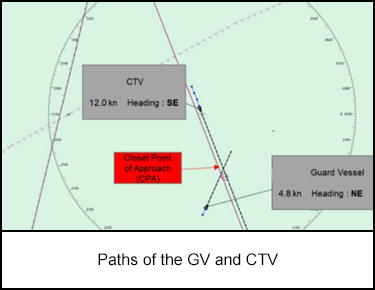
A crew transfer vessel (CTV) carrying three personnel was moving at a speed of 12.2 knots (14 mph), on the way to the port.
A guard vessel (GV), navigating northeast at 4.6 knots (5 mph), was conducting routine patrol operations near the boundary of an offshore wind site.
The two vessels approached one another in proximity, with a closest point of approach (CPA) of less than 90 metres (295 feet), just outside the site’s boundaries.
Despite receiving a radio warning and suggested course alteration from the GV, the CTV did not change its course.
Although no collision occurred, the event was classified as a serious near-miss with significant potential risk.
-
Why did it happen?
The CTV failed to comply with COLREG rule 15, which required it to take early and decisive action as the ‘give way’ vessel.
The CTV did not alter its course to 180° as recommended by the GV, maintaining speed and direction.
The CTV’s captain did not recognise the situation as hazardous; the anti-collision alert system did not trigger.
Communication between the two vessels was unclear or ineffective, as conflicting captain statements complicated investigation.
No audio logs were available for either vessel, limiting the accuracy of the incident analysis.

-
What did they learn?
Rule 15 of COLREGs must be actively followed; when in doubt, the ‘give way’ vessel must act decisively.
Electronic navigation systems should be regularly checked and maintained to ensure proper functionality.
The importance of a safety-first culture was reinforced, where captains must prioritise risk mitigation over assumptions.
Procedures must ensure availability of audio records for all vessel-to-vessel communication.
Crew training must be strengthened with specific focus on COLREG awareness and emergency response behaviours.

-
Ask yourself or your crew
How confident are we that all bridge crew understand and follow COLREG responsibilities during close encounters?
What systems do we have in place to ensure communication is timely, effective, and recorded?
Do we regularly test the functionality of our navigation and anti-collision equipment?
How does our organisation support a strong safety culture where proactive decisions are encouraged?
Would we recognise and act appropriately in a similar near-miss situation?

Add to homescreen
Content name
Select existing category:
Content name
New collection
Edit collection

What happened?
A crew transfer vessel (CTV) carrying three personnel was moving at a speed of 12.2 knots (14 mph), on the way to the port.
A guard vessel (GV), navigating northeast at 4.6 knots (5 mph), was conducting routine patrol operations near the boundary of an offshore wind site.
The two vessels approached one another in proximity, with a closest point of approach (CPA) of less than 90 metres (295 feet), just outside the site’s boundaries.
Despite receiving a radio warning and suggested course alteration from the GV, the CTV did not change its course.
Although no collision occurred, the event was classified as a serious near-miss with significant potential risk.

Why did it happen?
The CTV failed to comply with COLREG rule 15, which required it to take early and decisive action as the ‘give way’ vessel.
The CTV did not alter its course to 180° as recommended by the GV, maintaining speed and direction.
The CTV’s captain did not recognise the situation as hazardous; the anti-collision alert system did not trigger.
Communication between the two vessels was unclear or ineffective, as conflicting captain statements complicated investigation.
No audio logs were available for either vessel, limiting the accuracy of the incident analysis.

What did they learn?
Rule 15 of COLREGs must be actively followed; when in doubt, the ‘give way’ vessel must act decisively.
Electronic navigation systems should be regularly checked and maintained to ensure proper functionality.
The importance of a safety-first culture was reinforced, where captains must prioritise risk mitigation over assumptions.
Procedures must ensure availability of audio records for all vessel-to-vessel communication.
Crew training must be strengthened with specific focus on COLREG awareness and emergency response behaviours.

Ask yourself or your crew
How confident are we that all bridge crew understand and follow COLREG responsibilities during close encounters?
What systems do we have in place to ensure communication is timely, effective, and recorded?
Do we regularly test the functionality of our navigation and anti-collision equipment?
How does our organisation support a strong safety culture where proactive decisions are encouraged?
Would we recognise and act appropriately in a similar near-miss situation?
A CTV failed to alter course after a guard vessel’s warning and passed within 90m (295ft), creating a serious near miss with high collision risk.