-
What happened?
A fully loaded offshore unit was awaiting departure, with maintenance recently completed on the main crane.
During a routine crane function test, the crane’s boom was raised to 82 degrees and slewed clockwise.
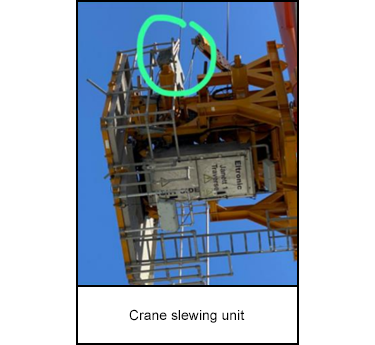
While the operator briefly monitored the control interface, traverse cables on the crane became caught on a nearby tower.
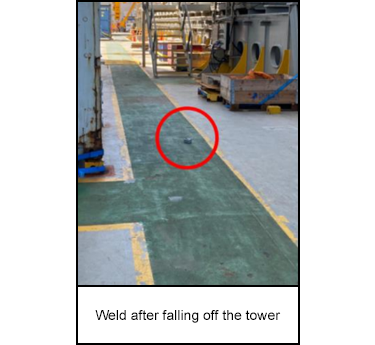
The resulting tension caused a weld on the tower to fail, producing two loud bangs.
The crane was stopped immediately, and a safety check confirmed that no personnel were injured.
The traverse blocks detached from the tower and fell to a designated platform area.
-
Why did it happen?
The boom angle selected was unsuitable for the operational layout of the unit and too low to avoid nearby structures.
There was an over-reliance on procedures and test angles used in previous operations, which were not applicable in this case.
The operator’s attention was temporarily diverted to the control screen at a critical moment.
No spotter or banksman was in place to monitor the crane’s path from the deck.
Available surveillance tools were not utilized effectively during the operation.
Pre-task briefings and planning were insufficient, with key risk factors overlooked.
-
What did they learn?
All crane movements must now be preceded by a formal safety briefing or pre-task talk.
A spotter or banksman is required for all crane operations, even when lifting is not taking place.
Surveillance camera systems must be used in accordance with clearly defined operational standards.
A minimum safe boom angle must be established and followed when operating near fixed structures.
The use of anti-collision zones and boom proximity sensors should be explored to enhance safety.
Alarms to detect excessive traverse tension should be considered to provide early warnings.

-
Ask yourself or your crew
How can we ensure task planning always considers the current setup, rather than relying on past experiences?
Are we fully using available monitoring tools to identify hazards in real time?
What steps can we take to make spotters a consistent part of crane operations?
Do we consistently carry out thorough safety briefings for all crane-related tasks?
Could similar risks exist in our operations that we have not yet identified?

Add to homescreen
Content name
Select existing category:
Content name
New collection
Edit collection

What happened?
A fully loaded offshore unit was awaiting departure, with maintenance recently completed on the main crane.
During a routine crane function test, the crane’s boom was raised to 82 degrees and slewed clockwise.
While the operator briefly monitored the control interface, traverse cables on the crane became caught on a nearby tower.
The resulting tension caused a weld on the tower to fail, producing two loud bangs.
The crane was stopped immediately, and a safety check confirmed that no personnel were injured.
The traverse blocks detached from the tower and fell to a designated platform area.

Why did it happen?
The boom angle selected was unsuitable for the operational layout of the unit and too low to avoid nearby structures.
There was an over-reliance on procedures and test angles used in previous operations, which were not applicable in this case.
The operator’s attention was temporarily diverted to the control screen at a critical moment.
No spotter or banksman was in place to monitor the crane’s path from the deck.
Available surveillance tools were not utilized effectively during the operation.
Pre-task briefings and planning were insufficient, with key risk factors overlooked.

What did they learn?
All crane movements must now be preceded by a formal safety briefing or pre-task talk.
A spotter or banksman is required for all crane operations, even when lifting is not taking place.
Surveillance camera systems must be used in accordance with clearly defined operational standards.
A minimum safe boom angle must be established and followed when operating near fixed structures.
The use of anti-collision zones and boom proximity sensors should be explored to enhance safety.
Alarms to detect excessive traverse tension should be considered to provide early warnings.

Ask yourself or your crew
How can we ensure task planning always considers the current setup, rather than relying on past experiences?
Are we fully using available monitoring tools to identify hazards in real time?
What steps can we take to make spotters a consistent part of crane operations?
Do we consistently carry out thorough safety briefings for all crane-related tasks?
Could similar risks exist in our operations that we have not yet identified?
During a crane test, cables snagged on a tower, causing a weld to fail and parts to fall. No injuries occurred.