-
What happened?
While carrying out subsea operations associated with blade removal, a technician suffered a laceration to their right thigh.
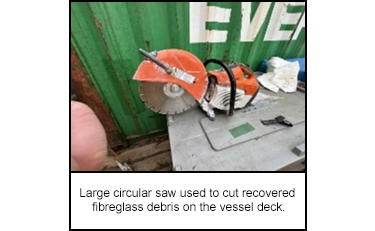
The injured person was cutting a section of recovered fibreglass debris on the working deck on an offshore supply vessel (OSV) using a large circular saw.
They paused cutting work for a moment and held the saw to their side with one hand while reaching over with their other hand to inspect the progress of the cut.
The injured person lost balance and, as they fell, the saw blade, still turning despite not being in use, made contact with their thigh. It cut through both the coveralls and work trousers, causing a laceration.
The injured person was assessed by the vessel medic and transport was arranged to take them to a hospital for further treatment.
-
Why did it happen?
The employee was not activating the trigger at the time of the incident, but the blade was still spinning under its own momentum when contact occurred.
During the initial investigation, it was discovered that the model of saw being used does not automatically brake the rotation of the saw blade when the trigger switch is released.
The risk assessment did not highlight this as a risk associated with this cutting task.

-
What did they learn?
All power tools on site without an automatic brake were removed from use.
Training and familiarisation will be provided to technicians who regularly use this type of saw.
The deck configuration was rearranged to provide more suitable and sufficient work areas for this type of task.
A suitable replacement tool with an automatic brake function will be procured.
Communicate the incident findings site-wide to raise awareness and update all risk assessments and method statements (RAMS).

-
Ask yourself or your crew
Is the tool being used adequate for the job at hand?
Are you aware of any safety or operational issues with a tool you are using?
Is the area you are working in stable and free of other hazards?
Have you followed the relevant G+ Lifesaving Rule: “Always use tools and equipment that are fit for the intended purpose”?
What opportunities were there to stop and reassess the task before the injury occurred?
Add to homescreen
Content name
Select existing category:
Content name
New collection
Edit collection

What happened?
While carrying out subsea operations associated with blade removal, a technician suffered a laceration to their right thigh.
The injured person was cutting a section of recovered fibreglass debris on the working deck on an offshore supply vessel (OSV) using a large circular saw.
They paused cutting work for a moment and held the saw to their side with one hand while reaching over with their other hand to inspect the progress of the cut.
The injured person lost balance and, as they fell, the saw blade, still turning despite not being in use, made contact with their thigh. It cut through both the coveralls and work trousers, causing a laceration.
The injured person was assessed by the vessel medic and transport was arranged to take them to a hospital for further treatment.

Why did it happen?
The employee was not activating the trigger at the time of the incident, but the blade was still spinning under its own momentum when contact occurred.
During the initial investigation, it was discovered that the model of saw being used does not automatically brake the rotation of the saw blade when the trigger switch is released.
The risk assessment did not highlight this as a risk associated with this cutting task.

What did they learn?
All power tools on site without an automatic brake were removed from use.
Training and familiarisation will be provided to technicians who regularly use this type of saw.
The deck configuration was rearranged to provide more suitable and sufficient work areas for this type of task.
A suitable replacement tool with an automatic brake function will be procured.
Communicate the incident findings site-wide to raise awareness and update all risk assessments and method statements (RAMS).

Ask yourself or your crew
Is the tool being used adequate for the job at hand?
Are you aware of any safety or operational issues with a tool you are using?
Is the area you are working in stable and free of other hazards?
Have you followed the relevant G+ Lifesaving Rule: “Always use tools and equipment that are fit for the intended purpose”?
What opportunities were there to stop and reassess the task before the injury occurred?
A technician suffered a thigh laceration when a circular saw blade continued rotating after the trigger was released.