-
What happened?
During installation of a lithium battery-powered winch on the flange level of a turbine, the battery in the winch became loose from its primary fitting.
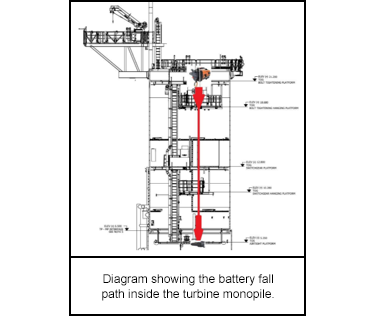
The secondary fitting also failed, which led to the 3.2 kg (7.05 lb) battery falling 17 m (55.8 ft) to the lowest platform inside the monopile.
Upon impact, the battery began emitting smoke, indicating damage to the power cell.
The turbine was evacuated and secured, and no persons were injured.
-
Why did it happen?
The battery in the winch had not been fully seated within its housing, causing it to become dislodged under the influence of gravity during operations.
In September 2025, the winch manufacturer released a revised double-locking mechanism for the battery to prevent dislodgement. This new design can also be retrofitted to earlier winch units. This had not been communicated adequately to the team.
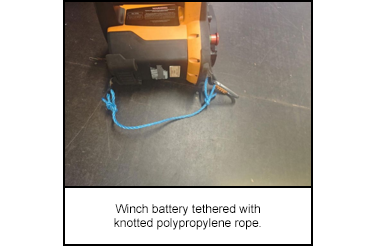
The battery had been tethered to the winch body using a knotted polypropylene rope, but the knot failed under load as the battery slid free.

-
What did they learn?
The risk assessment associated with the task did not provide any specific instruction regarding the tethering method to be used. The manufacturer recommends avoiding knotted rope and using a tool lanyard.
The dropped objects prevention scheme (DROPS) calculation performed during the investigation estimated the impact energy of the battery to be approximately 626 joules (462 ft-lb), which placed the potential outcome within the potential fatality zone.
Winch manuals are now included in each tower kit and a dropped object awareness campaign was completed.
-
Ask yourself or your crew
Do you have all the correct components for the parts you are installing?
Have you made yourself familiar with the tools and parts you are using?
Do you have the correct documentation with you to complete the task safely and in a timely manner?
Have you been made aware of any manufacturer's changes to parts or tools?
When working at height, are components correctly tethered?
How can we strengthen our controls to ensure that a single equipment failure does not escalate into a dropped-object or battery damage event?

Add to homescreen
Content name
Select existing category:
Content name
New collection
Edit collection

What happened?
During installation of a lithium battery-powered winch on the flange level of a turbine, the battery in the winch became loose from its primary fitting.
The secondary fitting also failed, which led to the 3.2 kg (7.05 lb) battery falling 17 m (55.8 ft) to the lowest platform inside the monopile.
Upon impact, the battery began emitting smoke, indicating damage to the power cell.
The turbine was evacuated and secured, and no persons were injured.

Why did it happen?
The battery in the winch had not been fully seated within its housing, causing it to become dislodged under the influence of gravity during operations.
In September 2025, the winch manufacturer released a revised double-locking mechanism for the battery to prevent dislodgement. This new design can also be retrofitted to earlier winch units. This had not been communicated adequately to the team.
The battery had been tethered to the winch body using a knotted polypropylene rope, but the knot failed under load as the battery slid free.

What did they learn?
The risk assessment associated with the task did not provide any specific instruction regarding the tethering method to be used. The manufacturer recommends avoiding knotted rope and using a tool lanyard.
The dropped objects prevention scheme (DROPS) calculation performed during the investigation estimated the impact energy of the battery to be approximately 626 joules (462 ft-lb), which placed the potential outcome within the potential fatality zone.
Winch manuals are now included in each tower kit and a dropped object awareness campaign was completed.

Ask yourself or your crew
Do you have all the correct components for the parts you are installing?
Have you made yourself familiar with the tools and parts you are using?
Do you have the correct documentation with you to complete the task safely and in a timely manner?
Have you been made aware of any manufacturer's changes to parts or tools?
When working at height, are components correctly tethered?
How can we strengthen our controls to ensure that a single equipment failure does not escalate into a dropped-object or battery damage event?
A winch battery became loose and fell 17 m (55.8 ft) inside a turbine monopile, emitting smoke on impact.